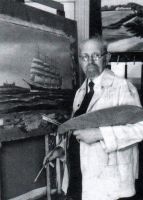
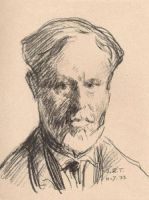
-
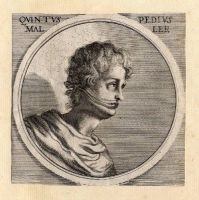
+/- 5 BC: Quintus Pedius, Painter (IT)
Quintus Pedius (died about 13) was a Roman painter and the first deaf person in recorded history known by name. He is the first recorded deaf painter and his education is the first recorded education of a deaf child. All that is known about him today is contained in a single passage of the Natural History by the Roman author Pliny the Elder.
Pedius was the son of Roman Senator and orator Quintus Pedius Publicola. Pedius was born deaf. On the advice of his paternal great-uncle Corvinus, and with permission from Augustus, Pedius was taught to paint. The boy turned out to be a talented painter, but died in his youth.
-

1454 - 1513: Pinturicchio, Painter (IT)
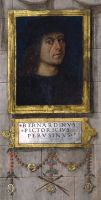
Pinturicchio, Bernardino an Italian painter of much celebrity, was born at Perugia in 1454. His real name was Betti Biagi, but he was often called Sordicchio, from his deafness and insignificant appearance, but Pinturicchio was his usual name.
He was a disciple of Pietro Perugino (q.v.). His earlier works no longer exist. He never perfected himself in the use of oil mediums, but was confined almost entirely to tempera. He went to Rome, and probably labored with Perugino in the Sistine Chapel.
He afterwards executed almost numberless frescos in the churches and palaces of that city. He was first patronized by the Roveri, and then by the Piccolomini. For Alexander VI he decorated the Apartamento Borgia in the Vatican; five of these rooms still remain in their original state.
His pictures in the Castle of S. Angelo have been completely destroyed. During his engagements in Rome he went twice to Orvieto, for the execution of commissions there.
The amount of his labors was surprising, but is explained by his great facility of execution and the employment of many assistants. He was not original 'in his compositions; he loved landscapes, but he cumbered them with too much detail; his figures of virgins, infants, and angels have a certain coarseness; he used too much gilt and ornamentation; his draperies were full, but often badly cast; his works are either too gaudy or very somber, no pleasing medium seeming to suggest itself to him; his flesh has the red outlines of the earliest tempera; and yet with all these faults he painted at a time when the great precepts of art were well known, and his works are good exponents of skilled labor in art without any striking or exceptional power in the artist.
It is scarcely possible here to give more than a list of the churches in which he painted: in Rome they were the Araceli, S. Cecilia in Trastevere, Santa Croce in Gerusalemme, and S. Onofrio. In 1496 he returned to Perugia, and undertook an altar-piece for S. Maria de' Fossi (now S. Anna), to be completed in two years. This is the most finished of his works, and more full of feeling than any other. He next adorned the collegiate church of Spello; but his works there are fast disappearing from the effects of dampness.
From: https://www.biblicalcyclopedia.com/P/pinturicchio-bernardino.html
Also see: https://en.wikipedia.org/wiki/Pinturicchio

The Crucifixion with Sts. Jerome and Christopher, 1471, oil on wood, 59 × 40 cm, Galleria Borghese, Rome.

Nativity, at Collegiata di Santa Maria Maggiore, Spello, Italy.
-
1526 – 1579: Juan Fernandez Navarrete, Painter (ES)
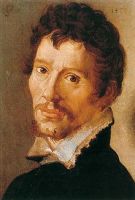
Juan Fernandez de Navarrete was born in the beautiful town of Navarre, Spain near the mountain range of the Pyrenees. He was called El Mudo (the mute) since childhood. He lost his hearing at the age of three and never learned to talk.
Juan's amazing drawings skills became evident when he began communicating his needs by drawing them out with charcoal on paper. The young artist never allowed his disabilities to hamper his dreams or ambitions and allowed his art to become his voice.
Like many Spanish painters he journeyed to Italy to soak up the rich traditions of painting and culture. Navarrete spent several years studying under Italian Master Titianin Venice.
In 1568 he was selected to become the official court painter to monarch Philip II of Spain. Once in Spain the majority of his career was spent working on altarpieces for the Escorial.
The paintings of Navarrete are rare. He was prolific but several were burned, lost or simply painted over by lesser artists. Navarrete major art-works were Nativity, Abraham and the Three Angels, andBaptism of Christ, 1568, now at the Museo del Prado in Madrid, Spain. He became known as the Spanish Titian and died in Toledo.

Baptism of Christ, 1568
The scene depicts the establishment of baptism as a sacrament, when Christ stands in the River Jordan and his cousin, St. John the Baptist, pours water over his head as a purifying ritual. Then God the Father appears in the heavens and pronounces that Christ is his son.
-
1585-1634, Hendrick Avercamp, Painter (NL)
Hendrick Avercamp (1585-1634) was one of the first Dutch landscape painters of the 17th century. He was deaf and mute and known as de Stomme van Kampen (“the mute of Kampen”).
He is especially noted for his winter landscapes of his homeland. His landscapes are characterized by high horizons, bright clear colors, and tree branches darkly drawn against the snow or the sky. His paintings are lively and descriptive, with evidence of solid drawing skills that made him an ideal recorder of his contemporary life.
His drawings were very popular in his time, and he sold many of them (enhanced with watercolors). His landscapes have a narrative quality, telling the tale of a crowd of people walking, skating, tobogganing, golfing, selling soup, making tea – each busy with a slightly different occupation.

Winter Landscape with Ice Skaters, Hendrick Avercamp, c. 1608
The high vantage point of this painting turns it into a sampler of human – and animal – activity during a harsh winter. Hundreds of people are out on the ice, most of them for pleasure, others working out of dire necessity. Avercamp did not shy away from grim details: in the left foreground crows and a dog feast on the carcass of a horse that has frozen to death.
-
1723 - 1792: Joshua Reynolds, Painter (UK)
Sir Joshua Reynolds (16 July 1723 – 23 February 1792) was an English painter, specialising in portraits.


BSL Zone (click on the picture to see the video)
Sharon Hirshman tells us about the life of the Deaf painter Sir Joshua Reynolds, played here by Deaf actor John Wilson. Influenced by a European style, Reynolds changed the direction of English art. At the age of 17, he became an apprentice to the portrait artist Thomas Hudson.
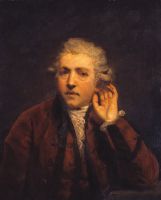
When he became deaf, he first used an ear trumpet then later had to rely on his family to relay information for him. In the most famous painting of him, he is cupping his ear, showing his deaf identity. Hirshman explains how Reynolds later believed his deafness improved his work.
-
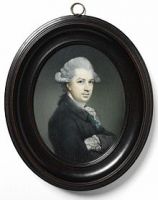
1742–1810: Richard Crosse, Painter (UK)
Richard Crosse was a leading English painter of portrait miniatures.
Crosse was born on 24 April 1742 in Knowle, in the parish of Cullompton, Devon; to parents John and Mary Crosse. His father was a lawyer, and his family were members of the landed gentry. Crosse was, like one of his sisters, completely deaf and never able to speak. He had at least six siblings.
Crosse began painting as a hobby, as was the fashion amongst the gentry. At the age of 16 he won a premium at the newly created 'Society for the Encouragement of Arts, Manufactures and Commerce' (the Society of Arts) in London. He then moved to London and, like Richard Cosway and John Smart, he studied at the new drawing school of William Shipley, the founder of the Society of Arts. He also studied at the Duke of Richmond’s Gallery.
Crosse exhibited his work at the new London societies: at the Society of Artists 1760–1796, the Free Society 1761–1766, and the Royal Academy 1770–1796. He lived and worked in Henrietta Street, in Covent Garden, London from 1760. His brother acted as intermediary between Crosse and his clients.
Basil Long in his book "British Miniaturists" (1929) regarded Crosse as a very accurate draughtsman who painted without hesitation or retouching and who will one day receive recognition for his sound, if modest, work.
Despite not being able to hear or speak, Crosse was very successful, and was highly regarded by his distinguished clientele. His clients included the Prince of Wales, and the Dukes of Cumberland and Gloucester. He painted his works mainly with watercolour on ivory; he also executed a few miniatures in enamel, a difficult and not always successful medium; as well as painting portraits in oil.
(..)
Crosse's work is refined, and in the best examples the sitters really look as if they could walk right out of the frame, they are so lifelike. Crosse’s miniatures often seem to be dominated by a shade of greenish-blue, maybe influenced by the early work of Joshua Reynolds. His works tend to have a greenish-blue hue to them, and his red pigments have faded a little over the years. He seldom signed his work."
"Documentary as part of the Deaf History series. This episode is about Richard Crosse, a deaf miniature portrait painter from hundreds of years ago. Reporter Sebastian Cunliffe visits London’s Victoria and Albert museum to look at miniatures dating back to the 16th Century, when photographs did not exist, and these portraits were the only way of preserving the image of loved ones. There, he tells us about Crosse, a deaf man born into the upper classes in Devon, who began painting as a hobby in his teens. When his talent was recognised, he moved to London to begin learning his trade."
-
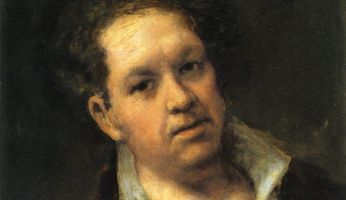
1746 - 1828: Francisco Goya, Painter (ES)
Born Francisco de Goya y Lucientes on March 30, 1746 in northern Spain.
Goya was a painter, draftsman and print maker artist who would later be called the “Father of the Modern Era” and be bestowed with the title of “first painter to the king.”
In the winter of 1792-93, when Goya was 46, he developed a mysterious illness that nearly killed him. He survived but lost his hearing, and for the next 35 years was “deaf as a stump.”
Of the nearly two dozen diagnoses that had been proposed as the cause of that illness, none fits the nature of the disorder better than a viral encephalitis, and of those viruses known to cause an encephalitis that results in deafness, none was more likely to have been responsible for destroying Goya’s hearing than the mumps virus.
(...)
And yet, only after the illness did he achieve full mastery of the face in his portraits. Only after his hearing was gone did his skill as a portraitist reach its zenith, possibly, it has been suggested, because deafness made him more aware of gesture, physical expression, and all the minute particulars of how faces and bodies reveal themselves.

The shooting of the rebels on the night of May 3, 1803 by Francisco de Goya
"This picture is not only a masterpiece of Goya, but also one of the highest achievements of European historical painting, its paradigm. It recreates a real event. After the battle of Puerto del Sol, the surviving Spaniards were executed on the night of May 3 at the hill of Principe-Pio.
But the unconditional certainty of the historical fact is translated into a universally significant symbol of heroism and suffering, courageous confrontation with blind and brutal force. Force, devoid of individuality, for the chain of French soldiers is anonymous – we do not see their face.
In the group of Spaniards,each image is individual, each carries a whole world, tragic and doomed. In the picture there is forever a moment before the shot, it finds here a duration, painful and endless." (https://painting-planet.com/the-shooting-of-the-rebels-on-the-night-of-may-3-1803-by-francisco-de-goya/)
-
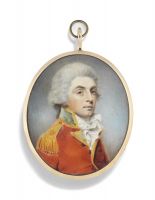
1750 – 1829: Charles Shirreff, Painter (UK)
Charles Shirreff was born in either 1749 or 1750. His last name has, at times, been spelled as Sherrif, Sherriff, or Shirref.
His father, Alexander Shirreff, was a wealthy wine merchant of South Leith in Edinburgh. At the age of three or four, Shirreff became deaf and mute. In 1760, his father approached Thomas Braidwood, owner of a school of mathematics in Edinburgh, seeking an education for the boy, then ten years old, in the hope that he could be taught to write.
Charles became Braidwood's first deaf student; soon afterward, Braidwood founded Braidwood's Academy for the Deaf and Dumb, the first school of its kind in Britain.
At the age of 18, in August 1769, Shirreff left Braidwood's Academy to study art in London at the Royal Academy Schools. He graduated in 1772 with a silver medal, and took up a career as a miniaturist."
-
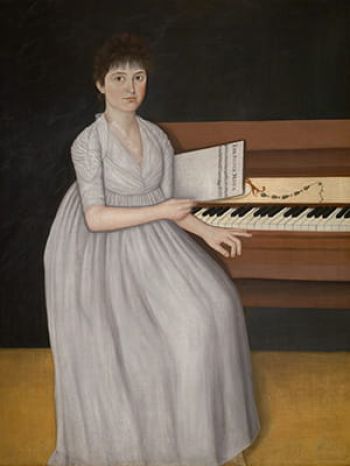
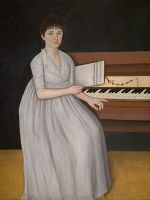
1766 - 1854: John Brewster Jr. (USA)
A extremely popular portraitist in colonial America, John Brewster, Jr. had an important and influential career spanning four decades. He painted more than 250 images of New England's middle and upper classes, creating a fascinating historical record. He developed a personal Folk art style that went on to influence other painters of the period as well as becoming a reference point for, later, modernist experimentation with flattened perspectives.
(..)
Despite facing many obstacles as a deaf artist working in the late-18th and early-19th century, Brewster overcame these to have a successful career.
As a prominent and well-regarded figure, he consequently did much to gain acceptance for the early Deaf community, challenging stereotypes and misconceptions and playing a role in the development of Disability Art.
His achievements and advocacy also inspired other deaf artists and educators to follow in his footsteps.
Source: https://www.theartstory.org/artist/brewster-john-jr/
Harlan Lane examines the extraordinary artist John Brewster Jr., and how his memberships within multiple worlds (Puritan, Federalist elite, Deaf and Art) converged to leave an enduring legacy.
33 min., 2014
-

1788 – 1839: Eelke Jelles Eelkema, Painter (NL)
"Eelke Jelles Eelkema (8 July 1788 – 27 November 1839), a painter of landscapes, flowers, and fruit, was born at Leeuwarden NL) as the son of a merchant. On account of his deafness, which was brought on by an illness at the age of seven, he was educated in the first Dutch institution for the deaf and dumb at Groningen (1799). The Flemish Gerardus de San, first director of the Academie Minerva, instructed Eelkema in the art of drawing.
In 1804, Eelkema obtained the first prize of the Academy. In 1808 he went back to his home town. In 1814 he was rewarded a stipend and lived in Paris for two years.[1] Eelkema then travelled by foot in France, Switzerland, and Italy, making sketches. In 1820 he had an exhibition of his work in Amsterdam. Afterwards he taught at the Atheneum in Franeker, communicating on a slate.
In 1823 Eelkema visited London, and later worked in a flower shop in Haarlem. In 1830 Eelkema had translated from the French language a theoretical work by the miniaturist André Léon Larue Mansion .He painted until he lost his sight, and died at Leeuwarden in 1839."
From: https://en.wikipedia.org/wiki/Eelke_Jelles_Eelkema
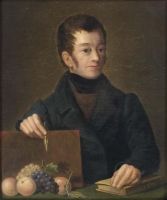
The painting at the top: Eelke Jelles Eelkema, painted by his student Cornelis Bernardus Buijs

Still Life with Flowers (c. 1815–1839)
-
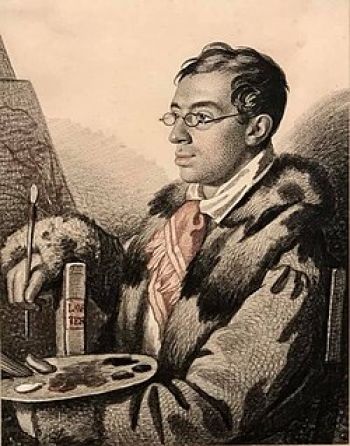
1794 – 1880: Karl von Hampeln (AT)
Karl von Hampeln was born deaf and mute into an Austrian family residing in Russia.
With the scholarship granted by Empress Maria Feodorovna, he was first admitted to a school for the deaf in Vienna and later studied at the Academy of Fine Arts Vienna. During the Congress of Vienna in 1815, he was introduced to Tsar Alexander I, who financed his continued stay in Vienna.
In 1816, he received a second-class court award as an Engraver. In 1817, he returned to Russia, and after 1825, he became a drawing teacher at the St Petersburg College for the Deaf. He gained recognition in the Russian capital as a portraitist. After a temporary short stay in London, he spent his final years in Vienna.
-
1799 - 1871: Mathias Stoltenberg (NO)
As the eldest son in a family that dominated the economic and political life in the Tønsberg area, Mathias Stoltenberg was destined to become something big. But he was weak, and at the age of 11 he lost his hearing. When in addition the father was ruined, it ended up that the son had to make a living as a wandering portrait painter and furniture repairman. Today, however, he is represented with a number of paintings in the National Gallery.
The rich man's son had started his education with a local priest early on, and he already had a solid knowledge base when he lost his hearing. His father sent him to Copenhagen, where the Norwegian-born doctor Peter Atke Castberg had established the first deaf-mute institute in the Nordic countries a few years earlier.
Mathias did not become a regular student at the department, and the doctors could not cure his deafness, but he stayed in the city to get an education adapted to his situation. He took a journeyman's certificate as a cabinetmaker, studied construction and architecture drawing and was a private student with Professor C. A. Lorentzen at the Academy of Fine Arts, where he specialized in portrait painting. He also got in touch with the Danish / Norwegian artist community.
(..)
The man who is today recognized as one of our great painters, was by his contemporaries most referred to as a carpenter. When his health finally failed, he settled on Østre Disen in Vang, where in recent years he lived as a "poor man".
from: https://nbl.snl.no/Mathias_Stoltenberg

View by Vang church, canvas 35.5x55.5. Signed Stoltenberg 1863 -
1815–1894: Léopold Loustau (FR)
Born on May 26, 1815, Léopold Loustau was deaf, the son of a quartermaster general in Napoleon's army and the heiress of a prominent industrialist in the Lorraine metallurgy industry.
He began his studies at the Institution for Deaf-Mutes in Nancy at the age of 14 in 1829 and remained there until 1831.
He studied at the École Nationale Supérieure des Beaux-Arts under the tutelage of Hersent and later Léon Cogniet. Cogniet offered painting advice, but Léopold refused to reap the benefits alone.
He persuaded Cogniet to teach painting to other deaf students at the Institut National des Jeunes Sourds (National Institute for Young Deaf People), and Cogniet agreed.
Among the deaf students was a promising painter, Frédéric Peyson. Peyson produced numerous paintings and exhibited regularly at the Salon from 1842 until his death.
(from the French Wikipedia, translated by Google Translate)
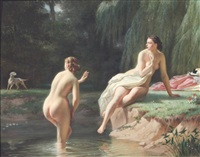
Startled on the Shore, 1865
-
1823 - 1875: Bruno Braquehais, Photographer (FR)
Bruno Braquehais was born in Dieppe, France in 1823. Although records don’t state how he lost his hearing, Braquehais was deaf from a young age. When he was nine years old, he started at the Royal Institute of the Deaf and Mute in Paris. He later found work as a lithographer.
His photographic work documenting the 1871 Paris Commune is considered an important early example of photojournalism.
In March 1871, a group of disenchanted soldiers, workers, and professionals seized control of Paris and set up a government known as the Paris Commune. This was one of the first major events in France to be "covered" by photographers. While many of these photographers focused on the ruins and destruction in the aftermath of the fall of the Commune, Braquehais ventured out of his studio at the height of the Commune's power, photographing its participants and events, most notably the toppling of the Vendôme Column. Braquehais published 109 of his photographs in a booklet, Paris During the Commune. After the fall of the Commune, government authorities used Braquehais's photos to track down and arrest the Commune's supporters.
In the years after the Paris Commune, Braquehais struggled financially, though he did do photographic advertising work for a clock company. By early 1874, he was bankrupt, and was jailed for 13 months for loss of confidence. He died in February 1875, a few days after his release.
While largely forgotten after his death, his work was rediscovered during preparations for the Commune's centennial in 1971, and his photographs have since been the exhibited at numerous museums, including the Musée d'Art et d'Histoire, the Musée d'Orsay, and the Carnavalet Museum.

Communards pose with the toppled statue of Napoleon following the destruction of the Vendôme Column on May 8, 1871

Paris Commune barricade
-

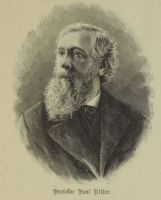
1829 - 1907: Paul Ritter, Painter (DE)
"At the age of four, Paul Ritter became deaf due to illness. He attended the school for the deaf and mute under the direction of Michael Völkel in Nuremberg. He studied painting and graphics at the Nuremberg School of Applied Arts and traveled to France, Italy, Denmark and Austria.
Ritter became known in particular for his large-format architectural pictures of old Nuremberg with historical figure staffage against the background of the historically faithful architecture of the old town.
His best-known pictures in the Nuremberg collection include the old show in Nuremberg with the reception of Gustav Adolf in 1632, the beautiful fountain in 1632, the introduction of the imperial regalia in Nuremberg in 1424 and the white tower with its surroundings.
He worked closely with his brother Lorenz Ritter (1832–1921) throughout his life. In 1888 Paul Ritter was appointed royal professor by Prince Regent Luitpold of Bavaria. With the help of his brother, he taught at the Nuremberg School of Applied Arts. Paul Ritter is considered the most important architectural painter of German historicism. On the 100th anniversary of his death, he was honored with a large exhibition in autumn 2007 by the collection of paintings and sculptures in the Nuremberg Museums."
From: https://de.wikipedia.org/wiki/Paul_Ritter_(Maler,_1829), translation into English: Google Translate

"The old show in Nuremberg"

Tomb at Johannisfriedhof (St. John's Cemetery) Grabnummer 145, Nuremberg (DE).
-
1860 - 1911: Heinrich Fick (DE)
Fick was a close friend of Paul Ritter, an art professor in Nuremberg who was also deaf, and worked as a painter in Munich.
There he married Amalie Spott (born 1886 in Munich; died 1978 in Munich), whose parents, Ferdinand Spott and Julie, were from Schweinfurt and were deaf. They had three children.
From 1899 onward, he lived in the Spott family villa at Hofmillerstraße 32. Ferdinand Spott, a modeler and engraver, had the villa built that year.
On April 2, 1898, he was one of the five founders of the deaf-mute society "Hufeisen – Kunst und Handwerk" (Horseshoe – Art and Craft),[4] which still exists today under the name Gehörlosenverein „Hufeisen“ 1898 München e. V. (Deaf Association "Hufeisen" 1898 Munich). The association's name comes from a horseshoe that the five founders found during a hike. The association's purpose was to protect deaf artists and craftspeople.
According to the later association chairman, Peter Funke, Fick was "a great personality, a respected artist in Munich."
In 1901, the Central Association for the Welfare of Deaf-Mutes in Need in Bavaria was founded, and Heinrich Fick served as its chairman until his death.
In 1908, the 7th German Congress of the Deaf-Mute took place in Munich under his leadership, and he was its president.
Heinrich Fick was an active mountaineer.
From the German Wikipedia, translated by Google Translate.
-
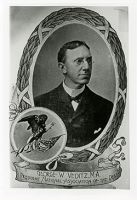
1861 - 1937: George W. Veditz, First Person to Film Sign Language (ASL)
Born in 1861 to German immigrants in Baltimore, Md., Veditz became deaf at age 8 due to scarlet fever. He was fluent in spoken English and German, among several other languages.
After he became deaf, he was privately tutored until he was 14, when he enrolled at the Maryland School for the Deaf (MSD) in Frederick. Although MSD at the time primarily trained its students in shoemaking, the school's principal hired Veditz as his private secretary and bookkeeper. Veditz wanted to enroll at Gallaudet in 1878 but could not afford to finance his education. (...)
In 1880, Veditz finally enrolled at Gallaudet, where he studied education. He graduated in 1884 as valedictorian of his class, and returned to MSD to teach for four years. He earned a master's degree from Gallaudet in 1887.
(..)
In 1904, Veditz became president of the National Association of the Deaf (NAD). He had strong opinions about preserving sign language, so during his years as president he worked closely with Oscar Regensburg, the first chairman of NAD's Motion Picture Fund Committee to produce some of the earliest films that recorded sign language.
Consequently, these videos are some of the most significant documents in deaf history.
Veditz was driven by the injustices he saw that included job discrimination, repression of sign language, and the overall treatment of deaf people as second-class citizens.
(...)
During his lifetime, Veditz also founded what would become the Gallaudet University Alumni Association and was involved in a World Congress of the Deaf held in conjunction with the World's Fair.
He passed away in Colorado at age 75.
https://hsldb.georgetown.edu/films/vid-bio.php?source=veditz
-
1867 - 1959: Johannes Graadt van Roggen (NL)
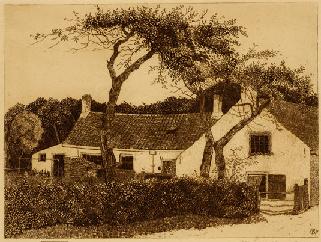
Johannes Mattheus Graadt van Roggen (Amsterdam, 28 May 1867 – Alkmaar, 26 August 1959) was a Dutch draftsman, painter and graphic artist. He is considered a forerunner of the Bergen School. He is also called Job Graadt van Roggen and was the second son of Jacob Frans Graadt van Roggen and Catharina Petronella Margaretha Zembsch.
Graadt van Roggen was deaf from the age of three as a result of meningitis. Throughout his youth he was a student of the Institute for the Deaf and Dumb (as that institute was then called) in Groningen. He made his first paintings when he was seventeen.
Because of his deafness, Graadt van Roggen was a visually oriented painter par excellence, who painted what he saw. He was a real plein air painter; he liked to paint outdoors. He rarely, if ever, painted indoors – there are a few still lifes and portraits. He always worked figuratively. Graadt van Roggen usually sought his subjects near his hometown of Bergen. He has created many dune landscapes (from Bergen aan Zee to Camperduin and Petten); He also regularly painted the Zeeland coast.
Other subjects are: harbours, portraits and cityscapes.
Graadt van Roggen has often been abroad. He preferred to paint around the Mediterranean.
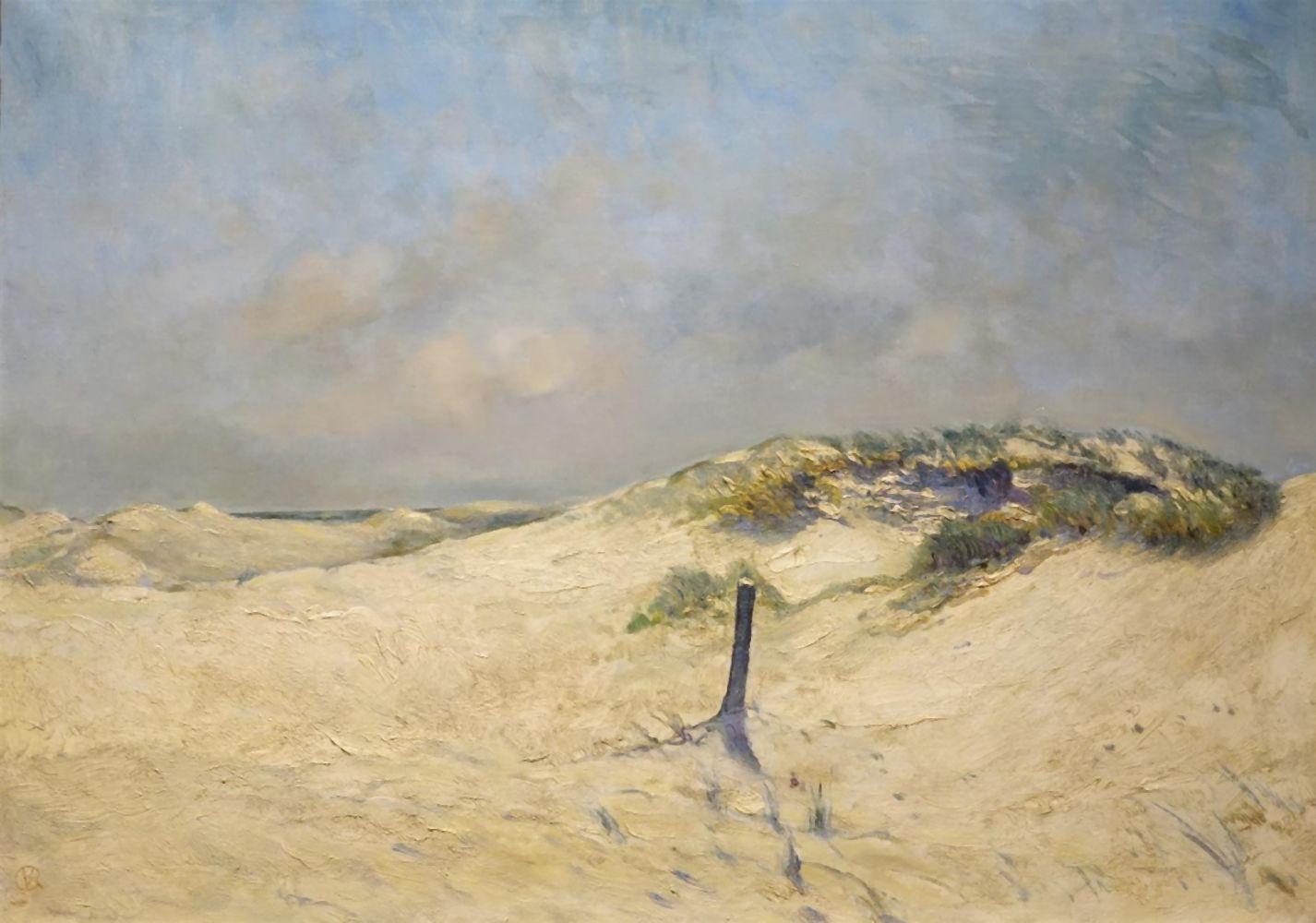
Zeeduin, ca. 1910
-
1870-1950: Peder Christian Pedersen, Painter (DK)
(translated from Danish by Google Translate)
Peder Christian Pedersen was born on 12-10-1870 in Øster Vandet near Thisted. Peder Christian Pedersen died on 11-5-1950 in Aalborg.
Peder Christian Pedersen was the son of the carpenter Anders Pedersen. One day, the father was working on a roof, he dropped a piece of wood into the head of his 3-year-old son Peder, who was injured and lost both his hearing and his speech. All his life, Peder was disabled and had to live like a deaf man.
At the age of 9, he came to the Institute for the Deaf and Dumb in Copenhagen. The quiet boy from North Jutland had a hard time committing himself; but soon the Danish teacher experienced Peder's abilities for drawing. He equipped the boy with drawing media. He immediately began to translate the day's experiences into drawings.
At the confirmation he came home to North Jutland again and would very much like to learn as a carpenter - this was impossible, however, and he came to study painting with Malermester Bloch. He became a very skilled painter and after his apprenticeship he moved to Aalborg, where he got a job as a painter.
He started painting - and ship paintings and other maritime environments became his specialty. There are i.a. a number of ship portraits from the Limfjord area. In September 1928, Denmark's pride, the school ship Copenhagen, lay at the quay in Aalborg, and Peder Pedersen was at the harbor and made a lot of sketches and noticed many details of the magnificent ship. When the ship sank a few months later and every man drowned, he painted the magnificent ship for the family. A market soon arose to have the magnificent ship hanging in the Danish living rooms as a reminder of Denmark's greatness on the world's oceans. Peder Christian Pedersen began painting countless "sofa pieces" of the School Ship Copenhagen, and he himself stated on his 70th birthday in 1940 that he had painted 10,000 paintings of the School Ship. Many he has made, as it still, to this day,

-
1872 - 1947: Jan Zoetelief Tromp (NL)
Johannes Tromp was born on December 13, 1872 in Jakarta (then Batavia). He came from an old Frisian family of mainly lawyers and civil servants. Jan was the eldest son of seven children; five boys and two girls.
Little John was a difficult and disobedient toddler, who would never listen. Until his maternal grandmother (“Grootje Zoet”, as she was called) accidentally discovered in a toy store that he was deaf. She rang a bell and beat a drum, but he didn't listen. She understood that Jan was deaf, and therefore deaf-mute.
'Grootje Zoet', who had been a widow for several years, has from that moment on devoted the rest of her life to her eldest grandson. When Jan was three years old, she sold her house and all her furniture and traveled with him to Europe. His parents and the other children stayed in the Indies.
After arriving in Holland, Grootje Zoet traveled with Jan to numerous specialists in Europe. But without result. Before he was even five years old, Jan attended the Institution for the Deaf and Dumb in Rotterdam; at that time the only institute in this field. Of course, learning to lip-read and learning to speak were the most important subjects.
With the preparatory summer course in 1887, when Jan was 13 years old, he started his education at the Academy of Visual Arts and Technical Sciences in The Hague and followed various courses there. In 1893 he passed the entrance exam for the Academy of Fine Arts in Amsterdam. He received special attention there from August Allebé, the then director of the Academy, who opposed the lyrical character of the Hague School with a more realistic naturalism.
After completing his studies, Jan settled in The Hague. There he was included in the circle of well-known painters, who showed an interest in the young, gifted and cheerful painter.
Jan Zoetelief Tromp died on September 28, 1947, aged almost 75, in Breteuil-sur-Iton."
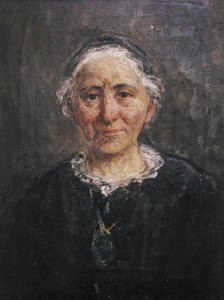
Marie Zoetelief Tromp – Blommers, 1947
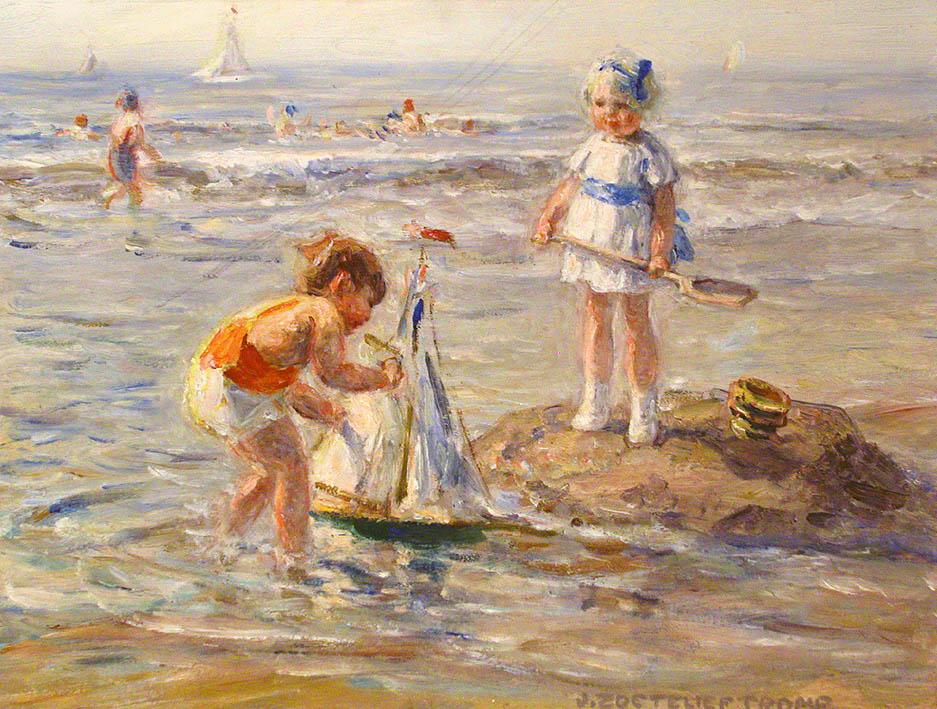
On the beach


 BSL Zone: Richard Crosse